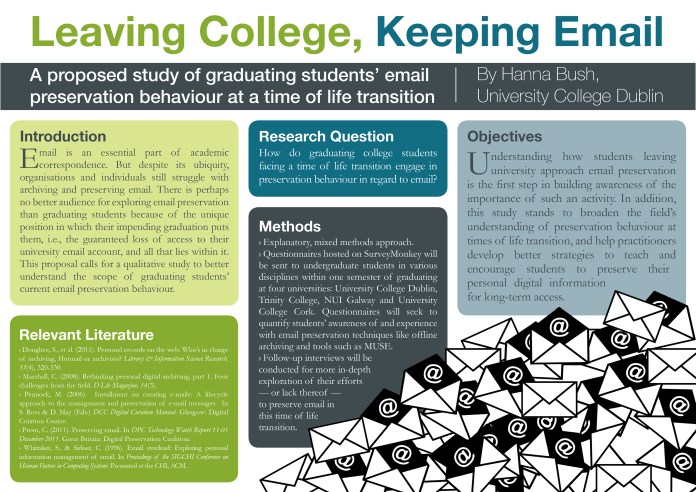
This is a poster I designed and wrote to propose a study of the email preservation behaviour of college students facing graduation.
Leaving College, Keeping Email:
A proposed study of graduating students’ email
preservation behaviour at a time of life transition
By Hanna Bush, University College Dublin
More than 50 years after the advent of email, it remains an essential part of academic correspondence. Indeed, it is the preferred method of communication for higher education — students at university are given academic email addresses upon registration. But despite its ubiquity, organisations and individuals still struggle with archiving and preserving email in a meaningful or ordered way (Pennock 2006, Prom 2011). Instead of undergoing the preservation of email, many people use their email accounts as an archive in and of itself, sending themselves important documents as attachments and forwarding important work messages to their personal accounts (Marshall 2008, Prom 2011). Despite being aware of the risks of losing this content in their email accounts — and placing high value on such content — people continue to engage in this behaviour, citing a lack of acceptable tools for other means of preservation (Donghee et al. 2011).
Research has shown that people tend to undergo personal preservation activities in earnest at times of life transition, such as graduation (Whittaker & Sidner 1996). Undergraduate students approaching graduation today are digital natives. They’ve grown up with digital technology and the Internet; they’ve been using email since they were children. But there exists little research on undergraduate students’ personal digital preservation strategies. There is perhaps no better audience for introducing and encouraging email preservation than graduating students because of their status as digital natives and because of the unique position in which their impending graduation puts them, i.e., the guaranteed loss of access to their university email account, and all that lies within it. The first step in building this awareness is to fully understand the scope of students’ behaviour. Therefore, this study is proposed to answer the research question: How do graduating college students facing a time of life transition engage in preservation behaviour in regard to email?
A mixed method, explanatory approach using questionnaires and semi-structured interviews with undergraduate students within one semester of graduating will be employed to gather the data for this research. Invitations to participate in a questionnaire regarding their awareness of and experience with different methods of email preservation including offline archiving and tools such as MUSE will be sent to graduating undergraduate students in a variety of disciplines at four national universities in Ireland — Trinity College, University College Dublin, University College Cork, and NUI Galway. The questionnaire will be hosted on the site SurveyMonkey. The aim will be to receive 150 completed surveys for data collection. Students will be asked to indicate at the end of the questionnaire whether they would be willing to participate in follow-up interviews for more in-depth exploration of their efforts — or lack thereof — to preserve email in this time of life transition. The aim would be to conduct at least 25 interviews with students from varying educational backgrounds.
Understanding how students leaving university approach email preservation is the first step in building awareness of the importance of such an activity. In addition, this study stands to broaden the field’s understanding of preservation behaviour at times of life transition, and help practitioners develop better strategies to teach and encourage students to preserve their personal digital information for long-term access.
References
Donghee, S., et al. (2011). Personal records on the web: Who’s in charge of archiving, Hotmail or archivists? Library & Information Science Research, 33(4), 320-330. http://dx.doi.org/ 10.1016/j.lisr.2011.02.004
Marshall, C. (2008). Rethinking personal digital archiving, part 1: Four challenges from the field. D-Lib Magazine, 14(3). Retrieved from http://www.dlib.org/dlib/march08/marshall/03marshall- pt1.html
Pennock, M. (2006). Installment on curating e-mails: A lifecycle approach to the management and preservation of e-mail messages. In S. Ross & D. May (Eds.) DCC Digital Curation Manual. Glasgow: Digital Curation Centre. Retrieved March 22, 2016 from http://www.dcc.ac.uk/ resource/curation-manual/chapters/curating-e-mails
Prom, C. (2011). Preserving email. In DPC Technology Watch Report 11-01 December 2011. Great Britain: Digital Preservation Coalition. Retrieved March 22, 2016 from http://www.dpconline.org/ component/docman/doc…/739-dpctw11-01pdf
Whittaker, S., & Sidner, C. (1996). Email overload: Exploring personal information management of email. In Proceedings of the SIGCHI Conference on Human Factors in Computing Systems. Presented at the CHI, ACM.
 Hanna Bush